


Introduction
Snowshoeing.
For some, it’s a way to continue hiking through the winter.
For others, it’s a necessary burden of winter travel because they can’t afford backcountry ski gear.
For still others, it’s a complicated morass of ill-fitting bindings, snowshoes falling off constantly, hinges icing up, snow and ice balls forming underfoot, and comical falls resulting from trying to maneuver a big paddle with a hinged foot.
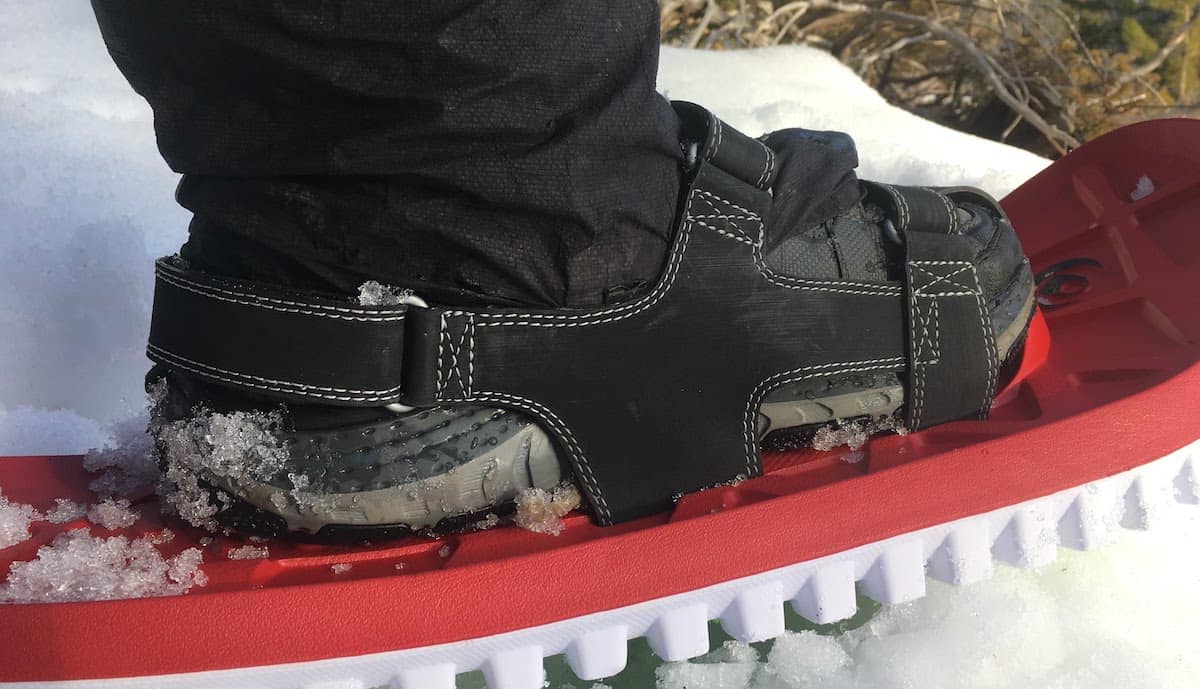
When you first see the Crescent Moon EVA Snowshoes, they look so different from anything else that you can’t help but wonder if they will save you from winter travel confusion and solve your snowshoeing distress.
Let’s see if they live up to their promise.

Features
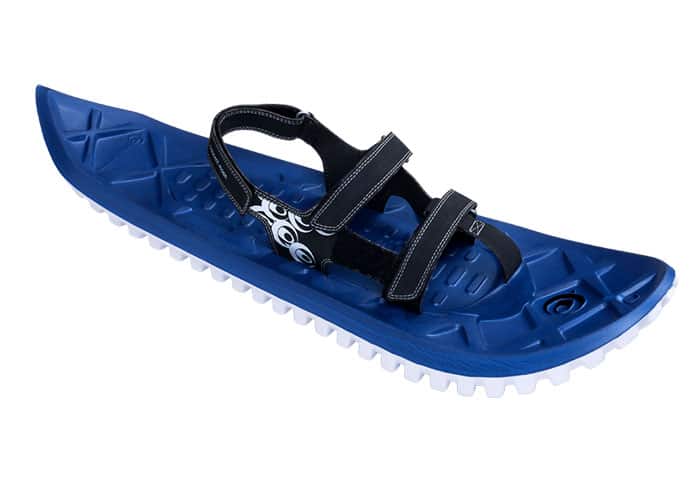
- Flexible rocker deck;
- Dual Density EVA foam deck construction (similar to a running shoe sole);
- Teardrop shape (as opposed to oval) to encourage a more natural stride and improve maneuverability;
- Hook and loop binding;
- Molded “sole” includes cleats / lugs for traction.
Specifications
- Dimensions: width 8 in (20 cm ) x length 24 in (61 cm);
- Manufacturer’s Claimed Weight: 3.5 lb (1.6 kg) / pr;
- User weight limit (recommended): < 200 lb (91 kg),
- Footwear size range: 7W to 14M.
Review Context
For the purpose of this review, I’m most interested in how the Crescent Moon EVA Snowshoes perform:
- while wearing soft, light, trail running shoes;
- in the context of multi-day backcountry travel (backpacking);
- on a wide variety of snow surface types, densities, and slope angles.
Description of Field Testing
These snowshoes were evaluated at the higher altitudes (9,000+ feet / 2743 m) of the Medicine Bow National Forest in Southeast Wyoming (Snowy Range) on snow surfaces that ranged from hard-packed trail to untracked, steep, backcountry slopes.

Performance Assessment
When evaluating the performance of the Crescent Moon EVA Snowshoes, I was interested in criteria that make these snowshoes somewhat unique (rocker design, cushioned deck, fixed binding, the durability of the EVA cleats). In addition, I was interested in how the Crescent Moon EVA Snowshoes performed relative to more traditional snowshoe models (binding use, traction, flotation, and climbing performance).
- Weight Verification
- Rocker Design / Break-in Period
- Cushioned Deck
- Fixed Binding
- Hook and Loop Binding Closures
- Cleat Durability
- Traction on Icy Surfaces
- Flotation in Deep Snow
- Climbing Performance (Steep Slopes)
Member Exclusive
A Premium or Unlimited Membership* is required to view the rest of this article.
* A Basic Membership is required to view Member Q&A events


Discussion
Become a member to post in the forums.
Companion forum thread to: Crescent Moon EVA Snowshoes Review
This Crescent Moon EVA Snowshoes review addresses the use of foam as a snowshoe material, combined with a fixed shoe binding.
Interesting, but look heavy. A pound more to use these over Quicksilvers?? ‘Corse a lot of that would be made up by using trail-runners vs a more traditional boot, I really, really want good crampons, too….
They should make kids’ sizes
Any information on how these perform on suncups?
Thanks.
I dunno about ANY snowshoes. My MSR Lightning Ascent ‘shoes are a lot more work than my Atomic TM 22 backcountry skis W/ climbing skins.
But then there’s the “learning curve” problem with skiing
And the cost of skis, poles, bindings and boots
Snowshoes and poles are much less expensive and don’t require much learning.
Six of one and a half dozen of the other.
Your review is so much appreciated because I was just looking to buy some snowshoes and I’d looked at these. The associate / owner? of my local climbing – outdoor shop was pretty down on the EVA Snowshoes (even though no one had purchased a pair or given him a review.) Great to have your insights before plunking down my cash (they seem somewhat over-priced – considering the likely inexpensive production costs???)
They remind me of that other plastic snowshoe from years ago, name had a Y in it, but can’t remember name quickly.
I wonder if the foam will get brittle/stiff in really cold temps?
A snowshoe starting with ‘y’:
Yowie ?
Yowie Snowshoe Review
They work fine, and are tough.
Cheers
Yes, the Yowie..lol
<b> Ryan</b>, I picked up a pair of these to try next weekend on an overnight snow shoe test trip. Cold temps. Good snow. I agree from a preliminary mile that a boot is not right for this snow shoe. Given that my trip will be in trail runners instead of boots, what did you do to manage foot warmth, specifically, in your trail runner when you used the crescents? I will likely be in temps of 10f to 25f. U mentioned warmth from below was good because of the foam, so I think this use-case is different than the “warm when wet” article posted this year, which is why I ask.
So maybe some sort of overboot instead of a second sock layer? . I was thinking: : coolmax injini toe sock / gortex rocky sock / lone peak 3 trail runner (non-wpb) / fleecy over boot / event gaiters.
… Perhaps my biggest question is if I should consider a wpb trail runner for this trip. I don’t like wpb boots or shoes – but winter and snowshoeing is unique. Lots of snow contact with the shoe. Typically my gortex socks are good enough but I have not snowshoed nor tried this temp range in a trail runner prior – so I’m interested in your opinion. Of course I’ll be less UL and bring extra socks and all that – but still worth hearing your opinions.
I made up some spats out of light coated nylon to keep the loose snow from getting on the front of the shoes. That worked fine.
Cheers
After testing them out more I grabbed a pair of low cut neoprene socks size 13 and cut out the arch. These are working well over the lone peak 3 with only a rocky sock and a trekking injini wool/coolmax toe sock in the 0-10f range. I really really appreciate the insulation from this product from below. I do have a few slips on really icy snow though and would be hard pressed to trust them on any ice verticals without side stepping.
Now I need to figure out how to keep my feet warmer in camp. So fair I’ve noticed my mint bell down booties are really warm enough. Also odd , but probably not unique, is that I’m noticing I need to balance cutting off my circulation with multiple layers vs smarter fewer layers. So far I’ve been warmest in the dartough/neoprenesock/down booty in camp. I’ll have to keep experimenting.
@ryan
Any thoughts on long term durability? I’ve noticed the “spikes” worn down a bit now after the second season of light wear and use. I also noticed you did not use them in a your recent winter backpacking video (great vid by the way!).
Hanz
I run all winter with snowshoes. I carry my skis on my backpack, run up our local ski mountain and switch over at the top to ski down. I have found my knees hurt less when I run in snowshoes compared to “running” with skins on my telemark skis.
i wear my favorite pair of trail running shoes and a pair of Forty Below Light Energy TR model overboots. These overboots are so great And have augmented the joy of winter traveling for me. They are so light and keep my feet surprisingly warm. It is a neoprene material around the shoe area and an over the calf height nylon gaiter above the ankle. They keep my feet warm down to 0 F (-17 C) . When it’s below zero I employ the Forty Below Simple Slipper insulation layer which is a zip on neoprene bootie, this provides another layer for heat retention. Those go on over my trail runners and under the overboots . The boots achieve “warmth from below” with lightweight EVA foam insoles that come in varied thicknesses to use depending how cold it is .
When winter camping the function of the Overboots come into their own for me. They are so soft that I am able to sleep with them inside my sleeping bag along with my trail running shoes in order to dry them out. So much more comfortable and convenient then trying to sleep with a big pair of wet winter boots! This system breathes exceptionally well and I’ve never had to consider using vapor barrier or Gore-Tex socks and the like. You can also wear certain types of crampons on these overboots if need be for hard pack, icy conditions. I have about 400 miles of use on the Light Energy overboots so far.
In camp I wear a pair of synthetic insulated booties , they are also by Forty Below and the product name is Camp Booties :) I don’t use down insulation for any of my gear winter or summer. That’s what I do… hope you find a system that works for you and your feet stay toasty and warm on your trip, I can’t say enough about the Forty Below’s if you want to check them out at 40below.com
Become a member to post in the forums.